
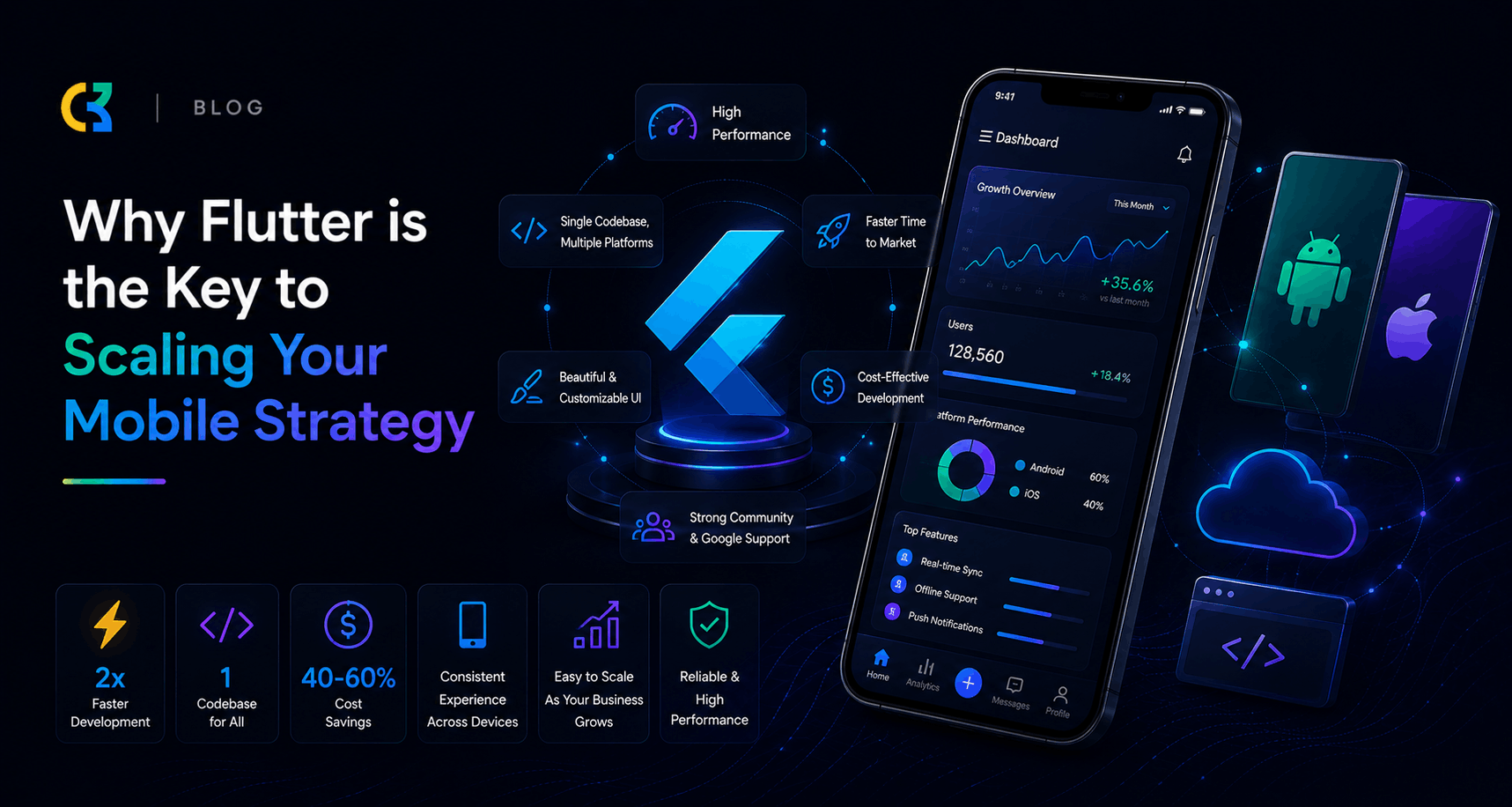
The Mobile Scaling Challenge
Every business leader knows the feeling. You’ve validated your product-market fit. Your user base is growing. Investors are asking about your roadmap. And then comes the question that keeps CTOs up at night: How do we scale our mobile presence without scaling our costs—and our complexity—exponentially?
The traditional answer has been native development: separate iOS and Android teams, separate codebases, separate release cycles, and double the maintenance burden. But in 2026, that answer feels increasingly outdated. The mobile landscape has evolved, and so have the tools available to navigate it.
Enter Flutter.
Google’s open-source UI framework has emerged as more than just a developer favorite—it has become the strategic foundation for companies navigating the journey from startup to scale. With over 2 million developers using it worldwide and a 46% share of the cross-platform developer market, Flutter has moved beyond experimental status to become a reliable foundation for business-critical applications.
But what does this mean for your mobile strategy? And why should Flutter be at the center of your scaling plans?
In this comprehensive guide, we’ll explore why Flutter is the key to scaling your mobile strategy—from cost efficiency and performance to team productivity and future-proofing. Whether you’re a startup founder, a CTO, or a product leader, this guide will help you understand why the world’s most innovative companies are betting on Flutter.
Chapter 1: The Numbers Don’t Lie—Flutter’s Market Dominance
Before diving into the “why,” let’s look at the “who” and “how many.” The statistics surrounding Flutter’s adoption tell a compelling story.
Market Share That Speaks Volumes
As of early 2026, Flutter holds approximately 46% of the cross-platform developer market share, outperforming React Native at 35%. This isn’t just a narrow lead—it’s a commanding position that reflects the framework’s practical advantages in real-world applications.
On the App Store, Flutter accounts for 16% of new apps, while on Google Play, that number jumps to 26%. These aren’t vanity metrics; they represent a fundamental shift in how companies approach mobile development.
Developer Adoption That’s Accelerating
The growth trajectory is equally impressive:
- 2 million developers currently using Flutter worldwide
- 10% month-over-month growth in adoption after March 2024
- 30,000 new developers join Flutter annually
- 93% satisfaction rate among Flutter developers surveyed
Enterprise Validation at Scale
Perhaps most importantly, Flutter has earned the trust of the world’s largest enterprises. BMW, Google Pay, Nubank, and Alibaba each serve 50-100+ million users on Flutter. Over 90 enterprise companies have been tracked using Flutter in production between 2024 and 2026.
The list continues to grow: Toyota, GEICO, SoFi, Universal, Etsy, SKIMS, Wendy’s, Headspace, NCL, LG, and ClickUp have all built their mobile strategies around Flutter.
When engineering leaders ask, “Who else is using Flutter in production at scale?” the answer is increasingly: Everyone who matters.
Chapter 2: The Business Case for Flutter
Market share and developer satisfaction are important, but they don’t pay the bills. Let’s talk about what actually matters to business leaders: ROI, time-to-market, and competitive advantage.
2.1 Cost Efficiency That Compounds
The economics of Flutter are straightforward: one codebase, multiple platforms. This isn’t just about saving money on day one—it’s about building a cost structure that scales efficiently.
Cross-platform development can cut overall project costs by 20-40% compared to maintaining two separate native builds. For a typical app development project ranging from $80,000 to $250,000, that translates to significant savings.
But the real savings come from maintenance. When you only have one codebase to update, bug-fix, and enhance, the math becomes even more compelling:
“Flutter projects often cost less to maintain because the framework owns the rendering layer. Slightly higher upfront cost is usually offset by fewer platform-specific bugs and lower long-term maintenance.”
Flutter saves 45% on average expenses and delivers 20-50% shorter development time compared to native development.
2.2 Faster Time-to-Market = Faster ROI
In today’s competitive landscape, speed matters. Every week of delay impacts adoption, revenue, and market position.
Studies show that companies using Flutter can cut time-to-market by up to 62% compared to those managing separate native teams. That means:
- Products launch faster
- Revenue comes in earlier
- Businesses can respond quickly to market shifts
- Competitive advantages are secured sooner
2.3 Unified Launches, Unified Revenue
One of the most overlooked benefits of Flutter is the ability to launch features simultaneously across platforms. No more staggered iOS vs. Android releases. No more Android users waiting weeks for features that iOS users already have.
“By consolidating development, businesses can roll out new features across platforms at the same time, meaning no more staggered iOS vs. Android launches. Instead, every user gets access to product updates immediately, creating a unified brand experience.”
For products with transactional features—ticketing, e-commerce, financial services—this unified approach helps maximize monetization, often delivering double-digit revenue gains.
Chapter 3: Why Flutter Beats the Alternatives
Every technology decision involves trade-offs. Here’s why Flutter consistently wins against the alternatives.
3.1 Flutter vs. Native Development
Native development (Swift for iOS, Kotlin for Android) offers the ultimate performance and platform-specific capabilities. But it comes at a steep price:
Separate teams, separate codebases, double the cost. For growing companies, this model doesn’t scale efficiently.
Flutter bridges the gap by delivering near-native performance with a single codebase. Unlike other cross-platform solutions, Flutter doesn’t rely on fragile “bridges” to native components. Its architecture compiles directly to machine code, enabling smooth animations and near-native performance across platforms.
Flutter delivers benchmarked startup times of 350–450 ms and reliable 60 fps rendering, even under demanding UI conditions.
3.2 Flutter vs. React Native
The Flutter vs. React Native debate has been settled by the market. Flutter leads with 46% market share compared to React Native’s 35%.
But the differences go beyond market share:
- Performance: Flutter compiles directly to native machine code; React Native uses a JavaScript bridge that historically impacts rendering speeds
- UI Consistency: Flutter provides pixel-perfect control across platforms; React Native relies on native components that can behave differently
- Development Velocity: Flutter’s Hot Reload enables sub-second code changes; React Native’s refresh is slower
- Code Reuse: Flutter achieves 95-99% code sharing across platforms
3.3 Flutter vs. Kotlin Multiplatform
Kotlin Multiplatform (KMP) is Flutter’s closest competitor in 2026. While KMP offers good performance and native UI flexibility, it involves higher development complexity. Flutter provides a more unified development experience with better tooling, a larger ecosystem, and a gentler learning curve.
Chapter 4: The Technical Advantages That Enable Scaling
Flutter’s business benefits are built on a foundation of technical excellence. Here’s what makes it work at scale.
4.1 True Multi-Platform, Not Just Cross-Platform
This distinction matters. While other frameworks can compile apps for iOS and Android, they “stop short of delivering consistent experiences across the full range of platforms enterprises depend on, including web, desktop, and embedded devices”.
Flutter is designed from the ground up to unify development across all of them:
- iOS and Android (mobile)
- Web (with near-native performance via WebAssembly)
- macOS, Windows, and Linux (desktop)
- Embedded systems (smart screens, car dashboards, kiosks)
Between 95% and 99% of Flutter source code is shared across platforms. This isn’t just convenient—it’s transformative.
4.2 Performance That Doesn’t Compromise
One of the primary concerns with cross-platform frameworks has traditionally been performance trade-offs. Flutter’s unique architecture addresses this head-on.
“The framework compiles Dart code directly to native machine code, eliminating the performance penalties typically associated with interpreted or bridge-based solutions.”
Flutter’s use of the Skia rendering engine delivers performance that rivals native apps, with the ability to run from 60fps up to 120fps when needed.
4.3 Hot Reload: Developer Productivity Supercharged
Flutter’s Hot Reload feature is more than a developer convenience—it’s a productivity multiplier. By injecting updated source code files into the Dart runtime without restarting the application, developers can:
- Experiment with UI changes instantly
- Add features and fix bugs in real-time
- Iterate on designs without losing app state
“Flutter’s hot reload feature provides a workflow where any change made by the agent is viewable instantly in the running app during development.”
The latest Flutter 3.44 release introduces Agentic Hot Reload via the Flutter MCP server, closing the feedback loop for AI-assisted coding.
4.4 Built for AI-Augmented Development
In 2026, AI isn’t coming—it’s already here. Flutter’s architecture makes it uniquely suited for AI-driven development workflows.
Key advantages include:
- Token reduction: Generate your app once in Dart instead of translating across platform-specific languages
- Consistency: A single source codebase ensures features remain identical across all platforms
- Self-correcting agents: Dart’s strongly typed language provides semantic guardrails that catch errors instantly
- Predictable code generation: Flutter’s compositional, declarative UI aligns with how LLMs generate structured data
4.5 Design Consistency at Scale
Maintaining brand consistency across platforms is a challenge that grows with your company. Flutter’s pixel-perfect control makes it easier.
“Flutter gives teams pixel-perfect control to create fully custom, branded interfaces, enabling consistency without sacrificing creativity. Enterprises can align engineering and design, accelerate delivery, and innovate customer experiences in ways that redefine business outcomes.”
Chapter 5: Enterprise Success Stories
The best evidence for Flutter’s scalability comes from the companies that have already scaled with it.
5.1 Google Pay: From Fragmentation to Unification
Google rebuilt Google Pay in Flutter, migrating from 1.7 million lines of separate iOS and Android code to a unified codebase. A proof of concept built by just three engineers scaled to a 150+ engineer effort, reducing feature development effort from 2x to roughly 1.2x and resulting in a 35% smaller codebase.
5.2 Nubank: Serving 100+ Million Customers
The largest independent digital bank outside Asia, Nubank serves over 100 million customers on a Flutter-powered app. After adopting Flutter, the company launched a new life insurance product in just three months—their fastest product launch ever—and saw a 30% improvement in merge success rates.
5.3 SoFi: 2.5+ Million Lines of Flutter Code
SoFi built its “financial super app”—combining banking, investing, budgeting, credit, loans, and insurance—entirely in Flutter.
The codebase is massive: 2.5+ million lines of Flutter code, making it one of the largest Flutter codebases in production. The company ships weekly and has invested heavily in AI-driven workflows to scale its growing engineering team.
“In the first couple of years, we added about a million lines of code. Last year, another million, and 500,000 last quarter alone. AI tools and a growing team make the curve steep.” — Phil Rabin, SoFi’s Director of Mobile Engineering
5.4 Betterment: Revitalizing a Legacy Codebase
Betterment, the online investment advisor managing $56+ billion in assets, completed a Flutter transformation that revitalized their codebase. Their engineering team has described how Flutter breathed new life into their development process.
Chapter 6: Future-Proofing Your Mobile Strategy
Technology evolves rapidly. The frameworks you choose today will either enable or constrain your future growth.
6.1 A Roadmap That Inspires Confidence
Flutter’s 2026 roadmap demonstrates Google’s continued investment:
- At least four stable releases for both Dart and Flutter in 2026
- 12 beta releases to ensure stability and performance
- Decoupling Material and Cupertino design systems into standalone packages to accelerate development
- Full-stack capabilities with Dart-powered Cloud Functions for Firebase
- Deeper integration with Google Cloud and AI frameworks
6.2 The AI-Ready Future
Flutter is positioning itself as the framework of choice for AI-augmented development. With support for agentic development, MCP servers, and Genkit Dart support for AI features, Flutter is ready for the next wave of innovation.
“Flutter’s support for a single shared codebase targeting multiple platforms, paired with a strongly typed language and powerful tooling, makes it a great companion to agent-driven development.”
6.3 The “Cross-Platform Debate Is Over”
As one industry observer put it: “The ‘cross-platform’ debate is over. Flutter has won. With Impeller now the gold standard for performance and WebAssembly making Flutter Web near-native, the demand for specialized developers is skyrocketing.”
Chapter 7: How Codemites Can Help You Scale with Flutter
At Codemites (www.codemites.com), we specialize in helping businesses build and scale mobile strategies with Flutter. Our expertise spans the entire development lifecycle—from strategy and architecture to development, testing, and ongoing optimization.
Why Partner with Codemites?
- Deep Flutter Expertise: Our team has years of experience building production-grade Flutter applications for enterprises across industries
- Strategic Approach: We don’t just write code—we help you build a mobile strategy that aligns with your business goals
- Scalable Architecture: We design systems that grow with your business, avoiding technical debt and architectural constraints
- AI-Augmented Development: We leverage the latest AI tools and Flutter’s agentic capabilities to accelerate your development cycles
Our Services
- Flutter App Development: End-to-end development of iOS, Android, web, and desktop applications from a single codebase
- Mobile Strategy Consulting: Expert guidance on technology selection, architecture, and roadmap planning
- Legacy Migration: Seamless transition from native or other cross-platform frameworks to Flutter
- Team Augmentation: Skilled Flutter developers to accelerate your in-house capabilities
- Performance Optimization: Ensuring your Flutter apps run at peak performance at any scale
Learn more about our Flutter development services
Contact our team for a free consultation
The Time to Scale with Flutter Is Now
The mobile landscape in 2026 is defined by speed, efficiency, and the ability to deliver consistent experiences across an ever-expanding array of platforms and devices. Flutter is uniquely positioned to help you meet these demands.
The evidence is overwhelming:
- Market leadership: 46% market share and growing
- Enterprise validation: 90+ enterprise companies, including BMW, Google Pay, and Nubank
- Cost efficiency: 20-40% cost savings
- Development speed: Up to 62% faster time-to-market
- Performance: Near-native performance with 60-120fps capability
- Future-ready: AI-augmented development, WebAssembly support, and a robust roadmap
Flutter isn’t just a framework—it’s a strategic advantage. It’s the key to scaling your mobile strategy without scaling your costs and complexity exponentially.
The question isn’t whether to adopt Flutter. The question is: How soon can you start?
Ready to Scale Your Mobile Strategy?
Codemites is here to help. Whether you’re starting from scratch, migrating from native development, or looking to optimize an existing Flutter codebase, our team of experts can guide you every step of the way.
Explore our Flutter development services
This article was brought to you by Codemites — your partner in building scalable, high-performance mobile applications with Flutter. Visit us at www.codemites.com to learn more.