
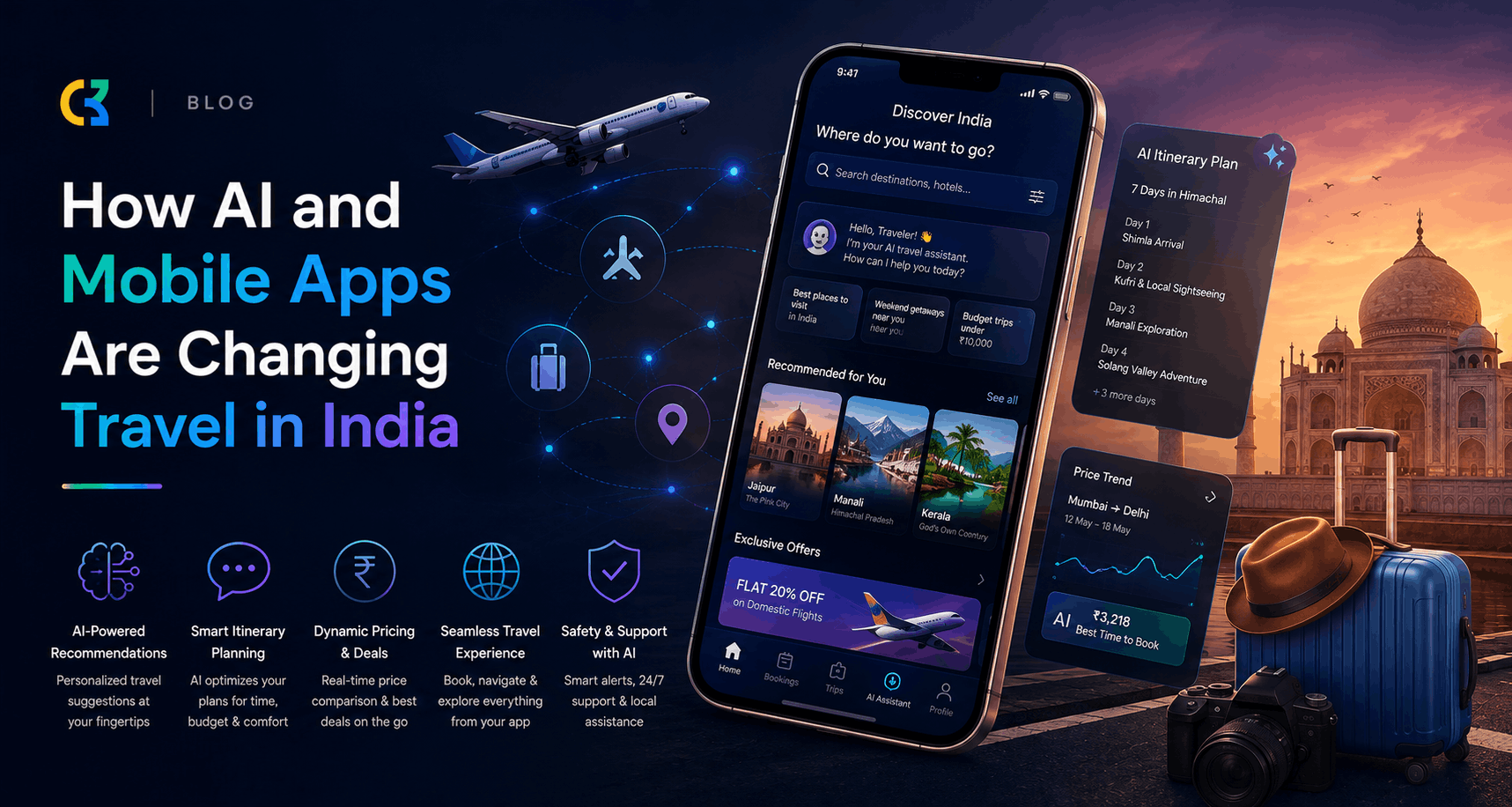
Travel planning in India has changed considerably with the growth of digital platforms. A traveler no longer has to depend entirely on travel agents, printed brochures, or phone calls to decide where to go and how to plan a trip. Websites and mobile applications now help people discover destinations, compare options, access travel information, and make bookings.
This change is also influencing how tourism businesses build their digital presence. A simple website may provide basic information, but modern travelers increasingly expect faster access to information, convenient booking experiences, personalized recommendations, and support throughout their journey.
Technology is therefore becoming an important part of the travel experience, and two areas in particular—artificial intelligence (AI) and mobile applications—are creating new possibilities for India’s tourism industry.
India’s Tourism Industry Is Becoming More Digital
The shift toward digital tourism is not limited to private travel companies. India’s Ministry of Tourism has also been developing digital infrastructure around tourism.
The Incredible India Digital Platform, for example, is designed as a unified digital ecosystem for travel information, experience planning, bookings, and destination discovery. According to the Ministry of Tourism, the platform includes a web portal, API integrations with third-party services, personalization, mobile applications for iOS and Android, and analytics.
The platform also incorporates AI-powered personalization to improve visitor experiences. Government material describes features such as personalized recommendations and access to information and travel services.
This is an important development because it shows that digital tourism is moving beyond simply putting brochures and destination information online. Technology can now help connect different parts of the travel journey through one digital experience.
How AI Can Make Travel Planning More Personal
One of the biggest opportunities for AI in tourism is personalization.
Travelers do not all want the same experience. A family traveling with children may look for something very different from a solo traveler, while someone interested in adventure tourism will have different priorities from someone looking for a wellness retreat.
AI can help travel platforms understand these differences and present information that is more relevant to an individual user.
For example, a travel platform could use information such as a user’s interests, preferred destinations, travel dates, or previous interactions to suggest relevant experiences. It could also help users find information through conversational interfaces rather than making them search through several pages.
This direction is already reflected in India’s digital tourism initiatives. The Ministry of Tourism has included personalization among the capabilities of its digital tourism platform.
For tourism businesses, the implication is straightforward: AI can become useful when it solves a real problem for the traveler rather than simply being added as a feature because it is popular.
Mobile Apps Can Stay With Travelers Throughout the Journey
Mobile phones are already an important part of how people access information while traveling. This makes mobile applications particularly useful for tourism businesses.
A well-designed travel app can bring several parts of a trip together. Travelers may use it to explore destinations, access booking information, manage itineraries, receive notifications, or find useful information while they are away from home.
The Ministry of Tourism’s Incredible India initiative includes mobile applications for both Android and iOS as part of its digital tourism ecosystem.
Mobile technology can also connect physical travel experiences with digital information. For example, a QR code placed at a tourist attraction, hotel, museum, or information point can give visitors quick access to a webpage, map, digital guide, or other relevant information. A business that wants to create QR code experiences can therefore use them as a simple bridge between something a traveler sees physically and the digital information they need on their phone.
For private travel companies, the possibilities can be even more specific. A tour operator could build an app around its own services, while a hotel group could create an application for reservations and guest services. A destination-focused business could combine travel information, itineraries, local experiences and customer support in one place.
The important point is that a mobile app should solve a genuine customer problem. Building an app simply for the sake of having one is unlikely to create much value.
Why Travel Businesses Need Better Web Applications
Mobile applications are only one part of the digital experience. A strong web platform is equally important because travelers often begin researching a trip through a search engine or website.
Modern travel websites can go well beyond displaying photographs and contact details. Depending on the business, they may include destination information, package details, booking systems, payment options, customer accounts, availability information and connections with other services.
The Incredible India Digital Platform provides a useful example of this broader approach. Its capabilities include a multilingual web portal, connections with third-party services, digital asset management, mobile applications, user-generated content and analytics.
With the growth of AI and no-code tools, it is reasonable to ask, is web development dying? The more accurate way to look at the change is that web development is evolving. Basic websites can be created more easily than before, but businesses with more complex requirements still need people who can understand their needs, build custom functionality, connect different systems, and maintain a reliable digital experience. Current industry analysis similarly describes AI and no-code tools as changing the development process rather than eliminating the need for web development altogether.
For a private tourism company, the technology will naturally be smaller and more focused. However, the underlying idea remains the same: the website should make it easier for people to discover information and take the next step.
For example, someone planning a trip to Kashmir may compare Kashmir tour packages, review different itineraries and inclusions, and decide which option best fits their travel plans before contacting a provider.
The quality of that online experience can influence whether a potential customer continues with the booking or leaves the website.
Where AI and Apps Can Work Together
AI and mobile applications do not have to be treated as separate technologies.
Consider a traveler using a tourism app. Instead of manually searching through dozens of options, the traveler could receive recommendations based on their interests and available time. An AI-powered assistant could help answer common questions, while the application could keep the selected itinerary and travel information in one place.
For businesses, combining these technologies can also make customer service more efficient. Routine questions can potentially be handled through digital assistance, while human employees can focus on situations that require personal attention.
However, these systems need to be designed around the actual needs of the business. A travel company with a small number of customers may not need a complicated AI system. Another company managing a large number of destinations, bookings and customer interactions may have a stronger reason to invest in one.
What Indian Travel Businesses Should Consider
For tourism businesses considering a new digital platform, the first question should not be, “Which technology should we use?”
It should be:
“What problem are we trying to solve for our customers?”
A business may need a better website because customers cannot easily find information. Another may need a mobile application because travelers need access to services while on the move. Another may benefit from AI because customers need help navigating a large amount of information.
Once the problem is clear, the technology can be chosen accordingly.
Businesses should also think about how their website, mobile application, internal systems and other services will work together. A disconnected collection of digital tools can create more problems than it solves. A properly planned system can provide a smoother experience for both customers and employees.
Building the Next Generation of Travel Experiences
India’s tourism industry has a large variety of destinations, travel businesses and customer needs. That makes technology particularly useful when it helps bring information and services together without making the travel experience unnecessarily complicated.
AI can make digital experiences more personalized, and tools like Predis.ai can help businesses create engaging content efficiently. Mobile applications can keep useful services accessible throughout a journey. Web applications can provide a central place for discovery, bookings and customer interaction. Even simple tools such as QR codes can make it easier for travelers to move between physical destinations and digital information.
For companies looking to build these kinds of solutions, the technology needs to be designed around their specific goals rather than around trends. That may involve AI development, custom software, web applications, mobile applications, or a combination of several solutions.
At Codemites, we work with businesses to build digital products and technology solutions around their specific requirements. As India’s travel industry continues to adopt digital tools, the opportunity is not simply to make tourism more technological. It is to make the overall travel experience more useful, accessible and convenient for the people using it.