
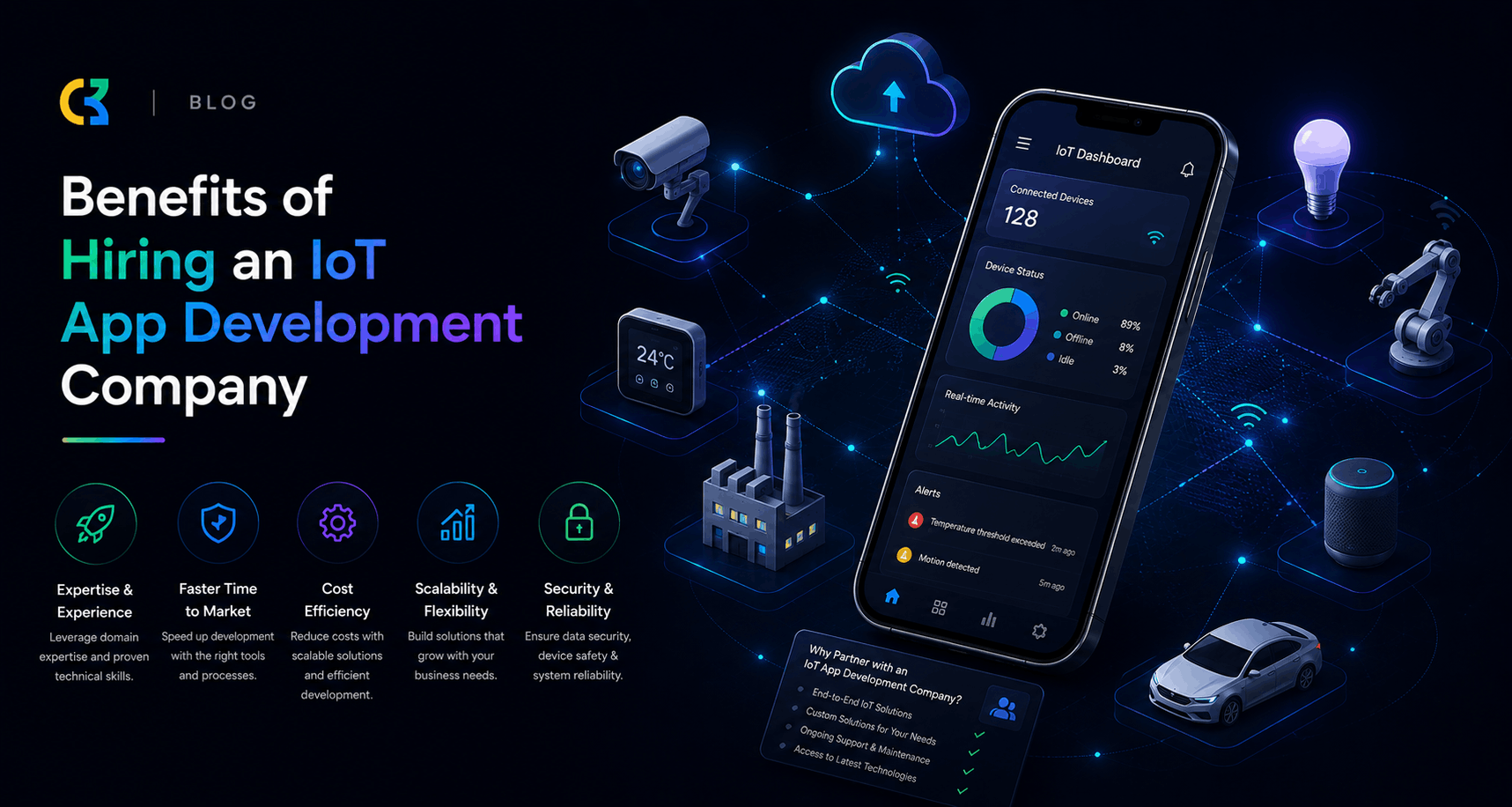
The Digital PrescriptionThe Internet of Things (IoT) has evolved from a futuristic concept into a fundamental business necessity. By 2030, the number of connected IoT devices worldwide is projected to exceed 32.1 billion. From smart homes and industrial automation to healthcare wearables and logistics tracking, IoT is fundamentally reshaping how businesses operate, interact with customers, and generate value.
But here’s the challenge: building an IoT application is not like building a standard mobile or web app. It requires deep expertise across multiple domains—hardware integration, cloud computing, real-time data processing, network protocols, firmware development, and robust security layers. The global IoT application development services market was valued at $29.0 billion in 2025** and is projected to reach **$117.3 billion by 2035, reflecting a 15% CAGR. This explosive growth underscores how aggressively enterprises are investing in connected intelligence.
However, despite this massive investment, many IoT projects fail due to poor software and hardware integration, clunky user experiences, and gaps in device management. This complexity is precisely why hiring a professional IoT app development company has become not just an option, but a strategic imperative.
In this comprehensive guide, we’ll explore the transformative benefits of partnering with an experienced IoT development partner like Codemites and why this decision can be the difference between IoT success and failure.
What Is IoT App Development?
Before diving into the benefits, let’s clarify what IoT app development actually entails.
IoT app development is the process of creating web or mobile applications that enable users to interact with connected “smart” devices. These apps serve as the command center of IoT ecosystems—they collect data from sensors, display real-time insights, allow remote device control, and automate complex workflows. As one industry expert puts it, “The strategic value of an IoT device is zero without a user-friendly mobile interface. The mobile app transforms raw sensor data into actionable intelligence”.
At its core, IoT app development covers several interconnected layers:
- Device connectivity and communication: Protocols like MQTT, CoAP, and Zigbee that determine how physical devices talk to your application
- Real-time data processing: Streaming pipelines that handle thousands of simultaneous device events without latency
- Edge computing: Processing data at the device level before it reaches the cloud, reducing bandwidth and improving response times
- Cloud infrastructure: Scalable backend systems that store, analyze, and manage IoT data
- Security frameworks: End-to-end protection for devices, data, and communications
Developing an IoT app requires proficiency in cloud computing, networking protocols, front-end and back-end development, data science, security, and embedded systems. Due to this multifaceted nature, many companies choose to outsource IoT development to specialized firms rather than building in-house capabilities from scratch.
Without the app, connected devices are little more than silent data generators. With the right app, businesses can turn that data into actionable insights, new services, and entirely new business models.
The IoT Market: Numbers That Matter
Understanding the scale of the IoT opportunity helps contextualize why investing in professional IoT app development is so critical:
- The global IoT market is projected to expand at a CAGR of over 20%, reaching a valuation of $2.38 trillion by 2032
- The IoT application development services market is valued at $29.0 billion in 2025** and projected to reach **$117.3 billion by 2035
- The IoT app market size has grown from $281.65 billion in 2025 to $325.46 billion in 2026, with a CAGR of 15.5%
- In 2025, the IoT market was valued at $445.3 billion** and is expected to rise to more than **$934 billion by 2033
- 92% of enterprises report a positive ROI from their IoT projects, driven by process automation and predictive maintenance
- Enterprises running connected intelligence are cutting operational costs by 20–30% consistently
The question is no longer if IoT is the future of business, but how quickly your organization can master the complexity of this integrated ecosystem.
Why Hire a Professional IoT App Development Company?
1. Access to Specialized, Cross-Functional Expertise
IoT development demands a rare combination of skills that are difficult to find in a single in-house team. You need embedded systems engineers who understand firmware, cloud architects who can design scalable data pipelines, mobile developers who can create intuitive interfaces, and security experts who can protect your entire ecosystem.
As the industry notes, “The full-stack nature of IoT (Embedded, Cloud, Mobile, AI) demands a cross-functional team. Success hinges on partnering with an ‘Ecosystem of Experts’ that can deliver end-to-end solutions”.
When you hire an IoT app development company, you gain instant access to a pool of specialized talent that would otherwise take years and significant investment to assemble internally. These professionals bring:
- Deep domain knowledge: Experience across industries like healthcare, manufacturing, logistics, retail, and agriculture
- Cross-functional coordination: Embedded engineers, cloud specialists, and app developers working in sync
- Latest technology expertise: Knowledge of cutting-edge tools, frameworks, and best practices
- Hardware-software integration: Understanding of how to bridge the physical and digital worlds
2. Faster Time-to-Market
In the IoT space, speed is a critical competitive advantage. Professional IoT development companies accelerate your timeline through:
- Rapid prototyping: Functional prototypes appear in weeks rather than months
- Continuous testing: QA runs alongside development, catching issues early
- Seamless deployment: Automated cloud and app pipelines minimize launch delays
- Established methodologies: Proven processes that anticipate and mitigate risks
- Prebuilt components: Leveraging existing libraries for geospatial visualization, alerting, and device provisioning, freeing the team to focus on business logic
The world of technology evolves non-stop—you have to hurry while the window of opportunity is still open, before someone else implements your idea before you do. A professional IoT development partner helps you seize that window.
3. Cost-Effectiveness and Budget Control
Building an in-house IoT development team involves substantial fixed costs—salaries, benefits, training, infrastructure, and ongoing overhead. With a professional IoT app development company, you gain flexibility and cost control.
Key cost advantages include:
- No recruitment overhead: Avoid the time and expense of hiring specialized talent
- Scalable team size: Scale up or down based on project requirements
- Predictable pricing: Clear cost visibility and budget predictability
- Reduced overhead: No need for expensive lab equipment, testing infrastructure, or software licenses
Most IoT proposals exclude firmware, device certification, and connectivity costs—professional partners provide the full breakdown so you know exactly what you’re investing in. Many businesses hesitate to scale IoT solutions because complexity grows fast. Professional development teams reduce that risk through modular development that supports incremental expansion without downtime.
4. End-to-End Security
IoT security is not an afterthought—it’s a foundational requirement. Connected devices operate in sensitive domains like healthcare, utilities, and logistics, where security breaches can have catastrophic consequences. The global IoT cybersecurity market is projected to grow from USD 16.07 billion in 2025 to USD 39.6 billion by 2033. Recent assessments indicate that over 70% of IoT devices are susceptible to hacking, jeopardizing personal privacy and global infrastructure security.
Professional IoT development companies implement robust security measures including:
- End-to-end encryption for data in transit and at rest
- Secure device authentication and authorization
- Regular security audits and penetration testing
- Compliance with industry regulations (HIPAA, GDPR, etc.)
- Over-the-air (OTA) update mechanisms for firmware security
- Advanced encryption, blockchain technology, and zero-trust frameworks
- SOC 2 Type II certification and ISO 27001 compliance, which means security controls are independently audited
In 2025 and beyond, “winning B2B IoT platforms must embed on-device AI, deliver enterprise-grade security from day one”. The cybersecurity challenges facing IoT deployments have escalated far beyond basic device authentication.
5. Scalability and Future-Proofing
IoT projects often start small but grow rapidly. A solution that works for 50 devices might fail for 5,000. Professional IoT developers build scalable architectures from day one, ensuring your system can handle growth without costly rewrites.
Professional teams ensure your IoT solution is:
- Modular: Components can be updated or replaced independently
- Cloud-native: Leveraging auto-scaling cloud infrastructure
- API-first: Easy integration with existing and future systems
- Technology-agnostic: Avoiding vendor lock-in that limits future choices
As Gartner’s 2025 Hype Cycle for IoT indicates, “IoT is moving beyond broad platforms and toward more specific, value-led applications that combine connectivity, edge processing, AI, and machine learning”. Professional partners stay ahead of these trends, ensuring your solution remains relevant.
6. Focus on Your Core Business
IoT development is complex, time-consuming, and resource-intensive. By outsourcing to a specialized partner, your internal team can focus on what they do best—running your core business.
A dedicated development team’s sole focus on a single project leads to higher productivity and efficiency. This focus results in faster development cycles, more innovative solutions, and a higher-quality product. Meanwhile, your team stays focused on strategic initiatives, customer relationships, and business growth.
7. Risk Mitigation
IoT projects carry significant risks—technical, operational, and financial. Professional IoT development companies have established methodologies to anticipate and mitigate potential risks, ensuring a smoother project lifecycle.
Professional partners help you:
- Validate concepts early: Build Proof of Concepts (POCs) and Minimum Viable Products (MVPs) to test ideas before full-scale investment
- Avoid costly mistakes: Learn from their experience with similar projects
- Ensure compliance: Navigate complex regulatory requirements
- Manage complexity: Coordinate hardware, software, and cloud components effectively
When IoT projects experience difficulties, most fingers point at implementation issues like poor integration, clunky UX, and gaps in device management. Professional partners address these root causes before they become problems.
8. Access to Advanced Tools and Infrastructure
Professional IoT development companies invest heavily in tools, platforms, and infrastructure that would be cost-prohibitive for most businesses to acquire independently.
This includes:
- Testing labs: Physical and virtual environments for device testing
- Cloud platforms: Enterprise-grade AWS IoT Core, Azure IoT Hub, and other platforms
- Development frameworks: React Native, Flutter, native iOS/Android tools
- Analytics tools: Advanced data visualization and business intelligence platforms
- CI/CD pipelines: Automated build, test, and deployment infrastructure
- Edge computing capabilities: Processing data closer to where it’s created for faster decisions and lower latency
9. Ongoing Support and Maintenance
IoT applications require continuous monitoring, updates, and improvements. Professional IoT development companies provide ongoing support and maintenance to keep your system running smoothly.
Support services typically include:
- 24/7 system monitoring
- Bug fixes and performance optimization
- Feature updates and enhancements
- Security patches and compliance updates
- Scalability planning and infrastructure management
- Over-the-air (OTA) updates for device firmware
10. Industry-Specific Insights
Experienced IoT development companies bring cross-industry knowledge that can be invaluable for your project. They’ve seen what works and what doesn’t across manufacturing, healthcare, retail, logistics, agriculture, and more.
Gartner’s 2025 analysis highlights “a shift from general IoT platforms to packaged applications built for sectors such as healthcare, sustainability, manufacturing, oil and gas, and logistics”. These applications increasingly include AI and ML capabilities, making reliable connectivity and high-quality data essential.
This perspective helps you:
- Avoid common pitfalls
- Identify opportunities you might have missed
- Benchmark against industry best practices
- Leverage proven patterns and solutions
Industries Benefiting from IoT App Development
IoT is transforming virtually every industry. Professional IoT development companies serve diverse sectors including:
Manufacturing: Predictive maintenance, real-time monitoring, supply chain optimization, quality control. Enterprises running connected intelligence are preventing failures before they happen and cutting operational costs by 20–30%.
Healthcare: Remote patient monitoring, medical device integration, asset tracking, wearable health devices. The global IoT healthcare market is projected to reach $83.81 billion, with IoT medical devices expected to top $166.5 billion by 2028 at a 32.1% CAGR.
Retail: Inventory management, customer analytics, smart shelves, personalized shopping experiences.
Logistics and Supply Chain: Fleet tracking, cold chain monitoring, route optimization, asset tracking. Industries including logistics, manufacturing, healthcare, agriculture, and energy are rapidly adopting IoT-based tracking systems.
Agriculture: Smart irrigation, soil monitoring, livestock tracking, crop yield maximization.
Smart Homes and Cities: Energy management, security systems, infrastructure monitoring, automated house management.
Energy and Utilities: Smart metering, grid optimization, renewable energy management.
Automotive: Connected vehicles, telematics, fleet management.
Quick-Launch Tools vs. Custom Development
Many businesses wonder whether to use no-code/low-code platforms or invest in custom IoT development. While quick-launch tools offer speed and lower upfront costs, they come with significant limitations:
Advantages of quick-launch tools:
- Speed to market: Weeks instead of months
- Lower upfront costs
- Easy experimentation
Limitations of quick-launch tools:
- Limited customization: Features constrained to what the platform offers
- Scalability issues: What works for 50 users might fail for 5,000
- Vendor lock-in: Switching platforms later is costly and disruptive
- Security concerns: Generic modules don’t always meet compliance or resilience needs
For businesses serious about IoT, custom development by a professional team is the better long-term investment. It provides the flexibility, scalability, security, and competitive advantage that no-code tools cannot deliver.
The IoT App Development Process
Professional IoT app development companies follow a structured process to ensure success:
1. Discovery and Strategy
This phase covers device compatibility, protocol selection, and compliance before any budget is locked. The partner you choose in discovery shapes your IoT architecture for the next five years.
2. Architecture Design
Designing the system architecture including device communication protocols, cloud infrastructure, data pipelines, and security frameworks.
3. Prototyping and MVP Development
Building functional prototypes to validate concepts and gather user feedback before full-scale development.
4. Full Development
Developing the mobile app, web dashboard, backend systems, and integrating with IoT devices.
5. Testing and Quality Assurance
Rigorous testing across devices, networks, and use cases to ensure reliability and performance.
6. Deployment and Launch
Deploying to production environments with minimal disruption.
7. Ongoing Support and Maintenance
Continuous monitoring, updates, and improvements to keep the system running optimally.
How to Choose the Right IoT App Development Company
When selecting an IoT app development partner, consider these critical factors:
1. Experience in IoT Development
Look for a proven track record of developing successful IoT solutions. Check the company’s portfolio for past IoT projects, focusing on their ability to deliver complex, multi-faceted solutions.
2. Expertise in Key IoT Technologies
A proficient IoT company should demonstrate expertise in cloud computing, sensors, edge computing, data analytics, and protocols like MQTT, CoAP, and HTTP.
3. Ability to Deliver Scalable Solutions
As your business grows, your IoT solution must handle increasing data traffic and more devices. The company should employ best practices in software architecture that ensure flexibility and adaptability.
4. Security Focus
With IoT devices generating vast amounts of data and being connected to critical business operations, security should be a top priority. Look for SOC 2 Type II certification and ISO 27001 compliance.
5. Transparent Development Process
Choose partners who demonstrate a transparent, supportive development process.
6. Industry Experience
Look for companies with experience across various industries, as demands and challenges in sectors like healthcare, manufacturing, retail, or agriculture can differ significantly.
Why Choose Codemites for IoT App Development?
At Codemites, we understand that IoT is more than just connecting devices—it’s about creating intelligent ecosystems that drive real business value. As an enterprise software development company based in India, we help developing enterprises and startup businesses with strategic insight on potential technological outcomes and new industry trends.
Our core strengths include:
- Custom Web and Mobile Application Development: We build IoT applications for iOS, Android, and web platforms that users love
- Enterprise Software Development: Scalable, secure solutions for complex business needs
- UI/UX Design: Intuitive interfaces that make IoT accessible and engaging
- Strategic Consulting: We help you navigate the IoT landscape and make informed decisions
We bring together expertise in cloud computing, data analytics, security, and mobile development to deliver IoT solutions that are:
- Secure: Enterprise-grade security from day one
- Scalable: Built to grow with your business
- User-friendly: Intuitive interfaces that drive adoption
- Future-proof: Designed for long-term success
The Internet of Things represents one of the most significant business opportunities of our time. With the global IoT market projected to reach $2.38 trillion by 2032 and 92% of enterprises reporting positive ROI from IoT projects, the potential is immense. But realizing that opportunity requires more than just smart devices—it requires smart applications that turn data into insights and insights into action.
Hiring a professional IoT app development company provides the expertise, speed, cost-efficiency, security, and scalability that in-house teams often struggle to achieve. From access to specialized talent and faster time-to-market to robust security and ongoing support, the benefits are compelling.
The question isn’t whether you should hire an IoT app development company—it’s which partner you should choose.
At Codemites, we combine technical excellence with strategic insight to deliver IoT solutions that drive real business results. Whether you’re a startup looking to validate an IoT concept or an enterprise ready to scale, we have the expertise to bring your vision to life.
Contact Codemites today to discuss your IoT app development needs. Let’s build something extraordinary together.
Ready to explore more? Check out our other services: